Navigating the I-10 corridor or the 610 Loop during a Houston rush hour is a high-stakes gauntlet for your vehicle’s factory paint. Between the heavy industrial traffic near the shipping channels and the constant construction debris in areas like Pearland and League City, rock chips are an inevitability, not a possibility. Protecting your investment requires more than a standard wax; it demands a sacrificial barrier capable of absorbing high-velocity impacts. While traditional Paint Protection Film (PPF) has been the industry standard for years, the emergence of hand-applied Liquid Paint Protection Film (LPPF) is changing how Houston drivers approach vehicle preservation.
What Is Traditional PPF and How Does It Protect Your Paint?
Traditional Paint Protection Film is a thick, thermoplastic polyurethane laminate applied to the surface of a vehicle to shield it from physical road hazards. It functions as a "skin" that absorbs the energy of rocks, salt, and road debris, preventing them from reaching the clear coat. For a daily Houston commute, this physical thickness is its greatest asset, providing a proven 90% reduction in paint chips compared to unprotected vehicles.
However, traditional PPF relies on a pressure-sensitive adhesive (PSA) to bond to the paint. In the extreme 100-degree heat and high humidity of a Houston summer, these adhesives can eventually dry out or become brittle. Because the film is pre-cut or trimmed from a roll, it inherently leaves edges. Over time, these edges can lift, trap dirt, or become visible as white lines against darker paint. While effective, traditional film is a "panel-by-panel" installation that often compromises the seamless aesthetic of high-end vehicles.
How Does Liquid Paint Protection Film (LPPF) Differ From Traditional Film?
Liquid Paint Protection Film (LPPF) represents an evolution in surface technology, moving away from pre-cut plastic sheets toward a hand-applied, high-build protective layer. Unlike traditional film, LPPF is applied as a liquid that cures into a durable, flexible, and crystal-clear barrier. This process allows for a truly seamless installation because there are no physical edges to wrap or hide. The film flows into every contour of the vehicle, providing 100% coverage on complex body lines that traditional film often struggles to bridge.
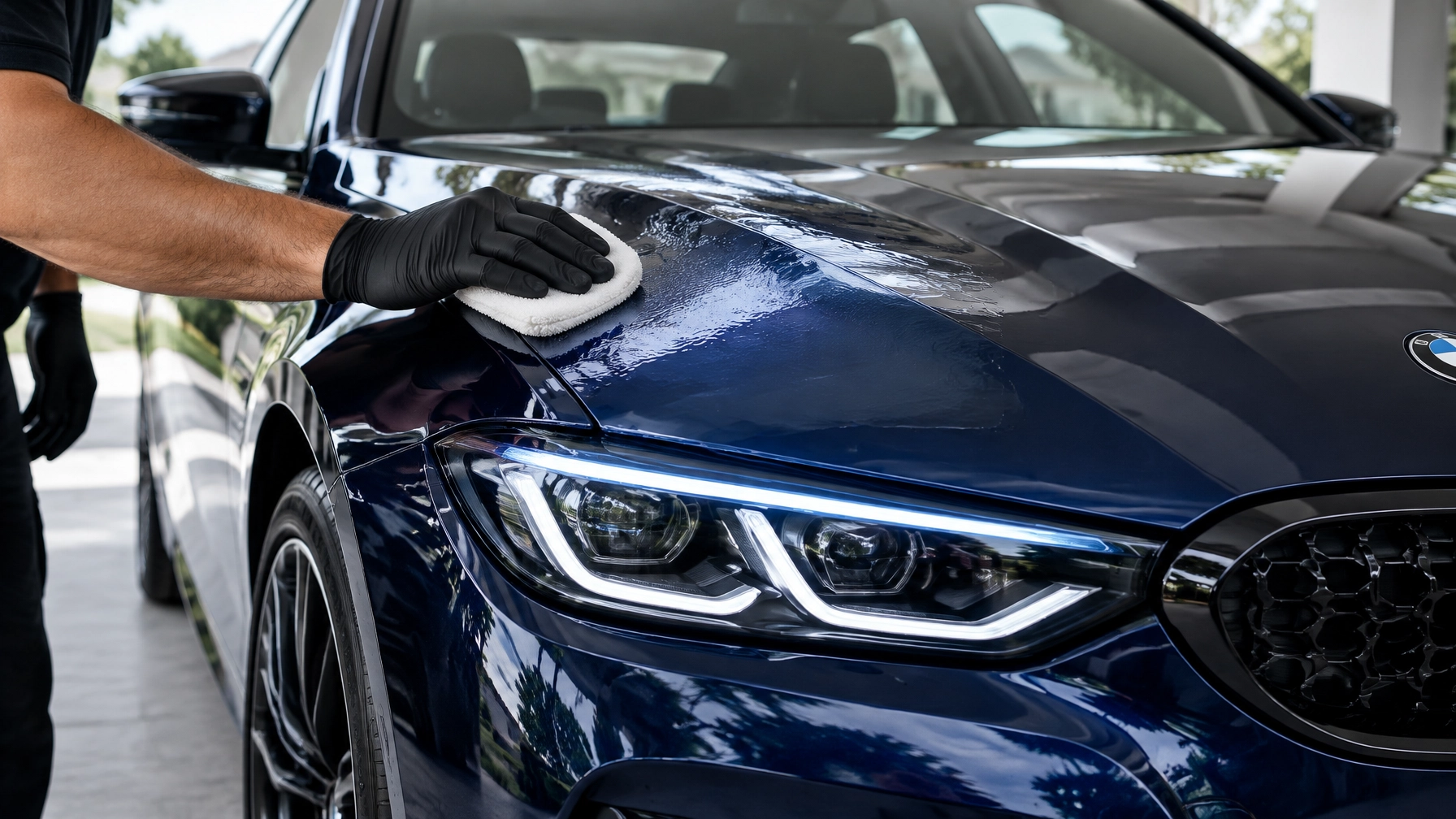
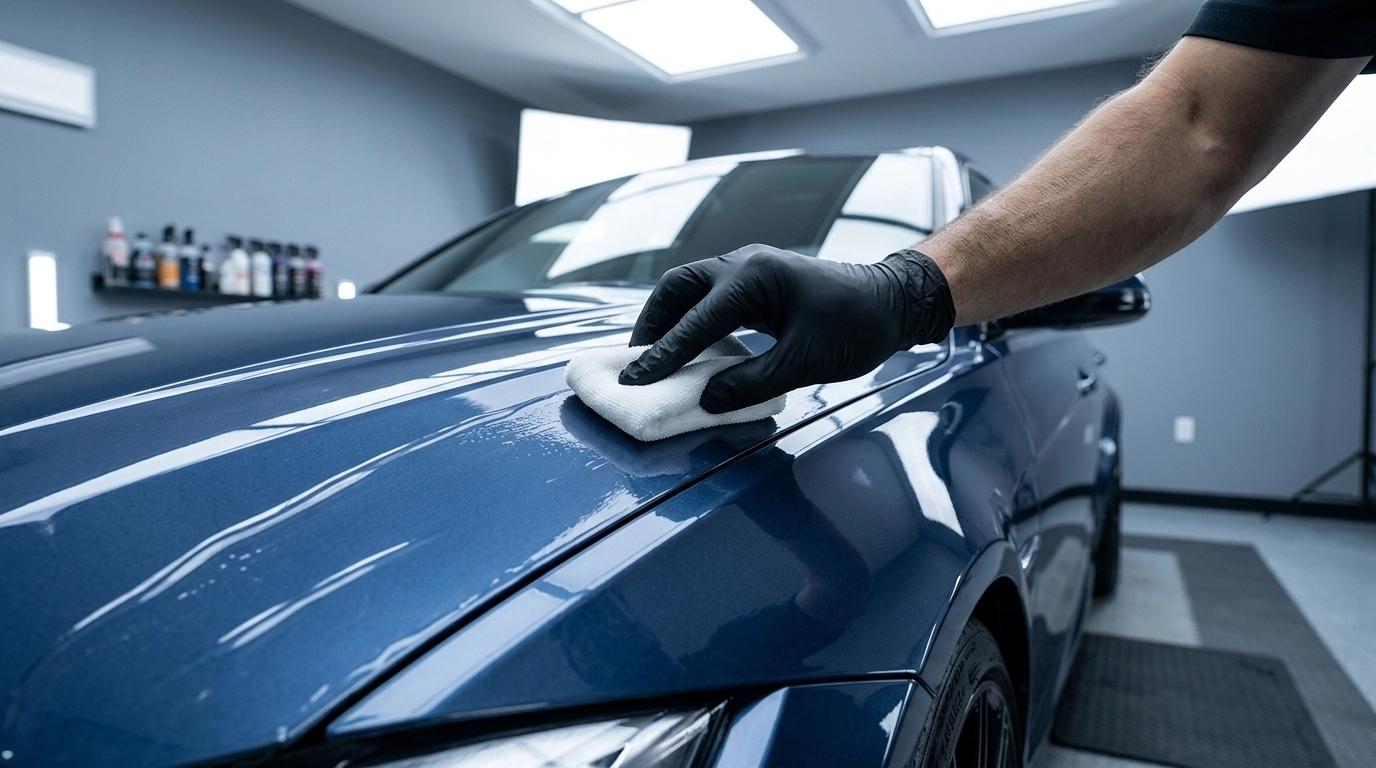
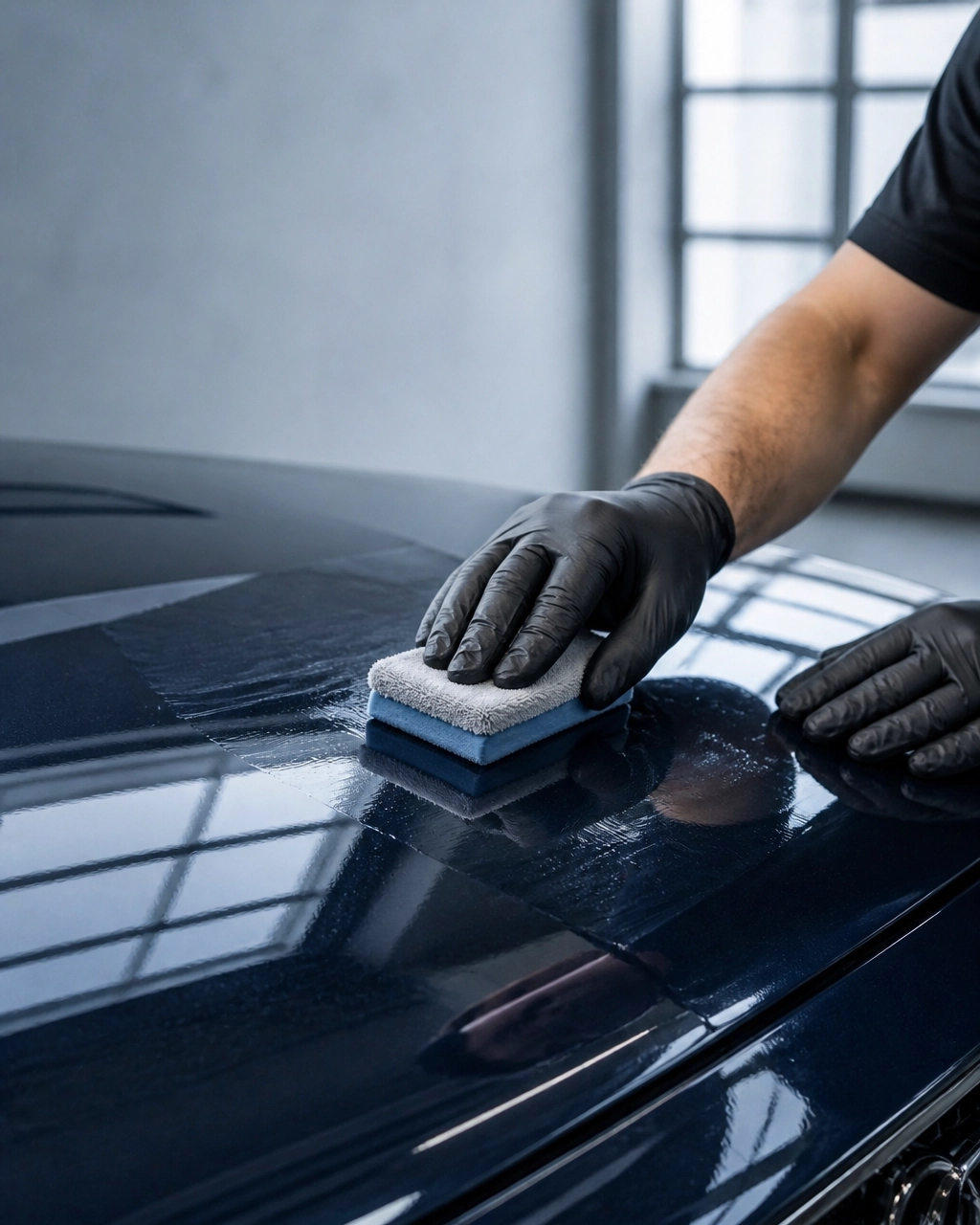
At Ceramic Enthusiasts, we utilize a meticulous, hand-applied approach for LPPF. This isn't a mass-produced spray-on solution; it is a craft-heavy process performed one car at a time. Our technicians use specialized hand tools and squeegees to ensure the liquid settles perfectly, creating a finish that is virtually indistinguishable from the factory clear coat. For drivers in Houston, TX, this means your car stays protected without the "wrapped" look that can distract from the vehicle's natural design.

Caption: A technician at Ceramic Enthusiasts hand-applying Liquid Paint Protection Film with a squeegee to ensure a seamless, edge-free finish.
Why Does LPPF Handle Houston’s Heat and Humidity Better?
The Gulf Coast climate is notoriously hard on automotive plastics and adhesives. Traditional PPF can suffer from "yellowing" or "orange peel" texture when exposed to constant UV radiation and 90% humidity levels. Because LPPF bonds at a molecular level without the need for traditional adhesives, it remains more stable under thermal stress. It does not shrink, pull back from edges, or bubble when the Texas sun beats down on your hood in a stationary traffic jam on the Beltway.
Furthermore, LPPF is engineered to be chemically resistant. In industrial areas like Pasadena, TX or South Houston, airborne chemical fallout from refineries can etch traditional film. LPPF’s dense molecular structure provides a superior defense against these environmental acids. When paired with an automotive ceramic coating, the result is a dual-layer defense system that handles both physical impacts and chemical staining with ease.
Can You Re-Level Rock Chips With Liquid PPF?
One of the most significant frustrations with traditional PPF is that once a rock punctures the film, the damage is permanent unless you replace the entire panel's film. A single rock chip on a $600 hood wrap often means stripping the whole piece and starting over. Liquid Paint Protection Film solves this through its unique ability to be manually re-leveled.
Because LPPF is hand-applied and cured, professional detailers can "fill" a deep impact mark with additional liquid material and then level it back to a smooth finish. This repairability is a game-changer for Houston commuters who face a daily barrage of gravel. Instead of living with a "scar" in your film or paying for a full replacement, LPPF allows for localized maintenance that keeps the vehicle looking flawless for the duration of its 10-year lifespan.

PPF Vs Ceramic Coating: Which One Do You Actually Need?
A common question we hear at our shop is whether a driver should choose PPF vs ceramic coating. The answer for a Houston driver is usually "both," as they serve different primary functions. Ceramic coating is a semi-permanent layer of protection that excels at UV resistance, chemical depth, and hydrophobic (water-shedding) properties. It makes your car incredibly easy to wash and protects against bird droppings and sap, but it cannot stop a rock from chipping your paint.
LPPF is your armor. It is a thick, sacrificial barrier designed to take the hit so your paint doesn't have to. At Ceramic Enthusiasts, we recommend the Platinum Package, which combines the impact resistance of LPPF with the self-cleaning slickness of ceramic coating. By applying a ceramic top-coat over the LPPF, you get the best of both worlds: a car that stays cleaner longer and is impervious to the physical hazards of auto detailing Houston environments.
How Does the "One Car at a Time" Approach Ensure Quality?
The biggest difference in the results you’ll see between a high-volume shop and an owner-operated studio like Ceramic Enthusiasts is the level of attention. Mass-market PPF installations are often rushed, leading to misaligned patterns, silvering (where the film stretches too much), and trapped dust particles. Because we operate on a one-car-at-a-time basis, every inch of the vehicle undergoes a rigorous paint correction process before any protection is applied.
We believe that the protection is only as good as the surface beneath it. If you apply LPPF over swirls or scratches, you are simply locking those defects in for a decade. By spending the time to polish the paint to a mirror-like finish first, we ensure that the LPPF enhances the clarity of your vehicle rather than obscuring it. This meticulousness is why drivers from Friendswood and Pearland trust us with their luxury and daily-driven vehicles alike.

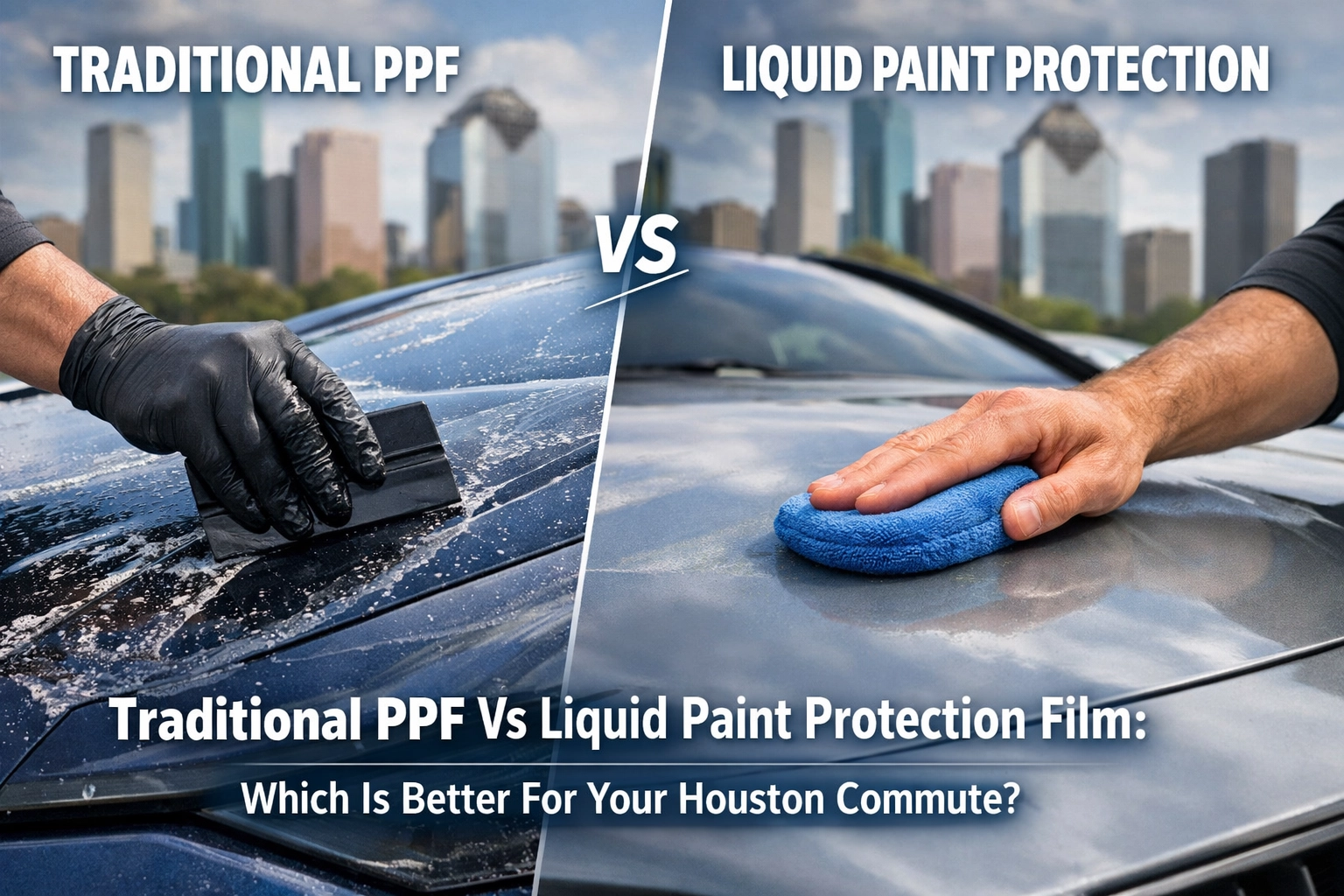
Caption: Close-up comparison of a traditional PPF edge versus the seamless, invisible transition of hand-applied Liquid PPF on a fender.
Which Option Provides the Best Long-Term Value for Houston Drivers?
While the initial investment in Liquid Paint Protection Film may be higher than a partial-front traditional PPF kit, the long-term value is undeniable. LPPF is rated for up to 10 years of durability, nearly double the lifespan of many entry-level films that begin to degrade or yellow after five years in the Texas sun. When you factor in the lack of adhesive removal labor costs during collision repair and the ability to repair minor chips without replacing entire panels, LPPF becomes the more economical choice for long-term ownership.
Furthermore, the aesthetic value cannot be overstated. A vehicle protected with LPPF maintains its original lines and "depth" of color. There are no seams to wax around and no peeling corners to worry about. For those looking to maintain the highest possible resale value for their vehicle in the competitive Houston market, a seamless, well-documented LPPF installation is a significant asset.

Is Your Vehicle Ready for the Ultimate Houston Shield?
Choosing between traditional PPF and Liquid PPF comes down to your expectations for finish and longevity. If you want a proven, physical barrier and aren't bothered by the occasional visible edge, traditional film is a solid choice. However, if you demand a "hidden" layer of armor that can be repaired, resists the Houston humidity, and offers a seamless look, Liquid PPF is the superior technology.
At Ceramic Enthusiasts, we specialize in tailoring protection packages to your specific driving habits. Whether you need a full front-end LPPF application for your highway commute or a comprehensive ceramic coating for your weekend show car, our owner-operated approach guarantees a result that exceeds shop-quality standards.
Don't let another commute on I-45 leave its mark on your paint. Connect with us today to discuss which protection level is right for your vehicle.
Contact Ceramic Enthusiasts at 281-626-9384 to schedule your consultation and see the difference that hand-applied protection makes.