Houston drivers face an environmental gauntlet every time they pull out of the driveway. Between the relentless UV radiation, the suffocating humidity of the Gulf Coast, and the abrasive industrial fallout near Baytown and Pasadena, your vehicle’s factory clear coat is essentially on a countdown to failure. Without professional-grade intervention, the deep gloss of your new car will inevitably transition into a chalky, oxidized haze within just a few years.
At Ceramic Enthusiasts, we’ve spent over a decade watching the Texas sun punish unprotected paint. We’ve seen how standard waxes evaporate in days and how even high-quality clear coats struggle against thermal expansion. This is why we have pioneered the application of Liquid Paint Protection Film (LPPF) in the Houston area. It is not just another layer of protection; it is a fundamental shift in how your vehicle interacts with its environment.
How Does Extreme Texas Heat Destroy Your Vehicle’s Finish?
The Texas heat kills paint through a combination of UV degradation, oxidation, and constant thermal expansion. When the temperature hits 105 degrees in Pearland or Sugar Land, the actual surface temperature of a dark-colored car can soar past 150 degrees. This extreme heat causes the metal panels and the paint layers to expand. As the evening cools down, these materials contract. This daily cycle creates microscopic fractures in the clear coat, which eventually lead to peeling and "checking."
UV radiation acts as a silent catalyst for chemical breakdown. These high-energy rays penetrate the clear coat and break down the molecular bonds of the paint. You see the result as oxidation, that dull, white, chalky residue that makes a once-vibrant red car look pink. Furthermore, the high humidity in areas like League City and Friendswood traps moisture and environmental pollutants against the surface. When the sun hits that moisture, it acts like a magnifying glass, etching bird droppings, tree sap, and acid rain deeper into the finish than it would in a drier climate. Without a sacrificial barrier like LPPF, your paint is the only thing standing between these elements and total degradation.
What Is Liquid Paint Protection Film and How Does Re-Leveling Restore a Smooth Finish?
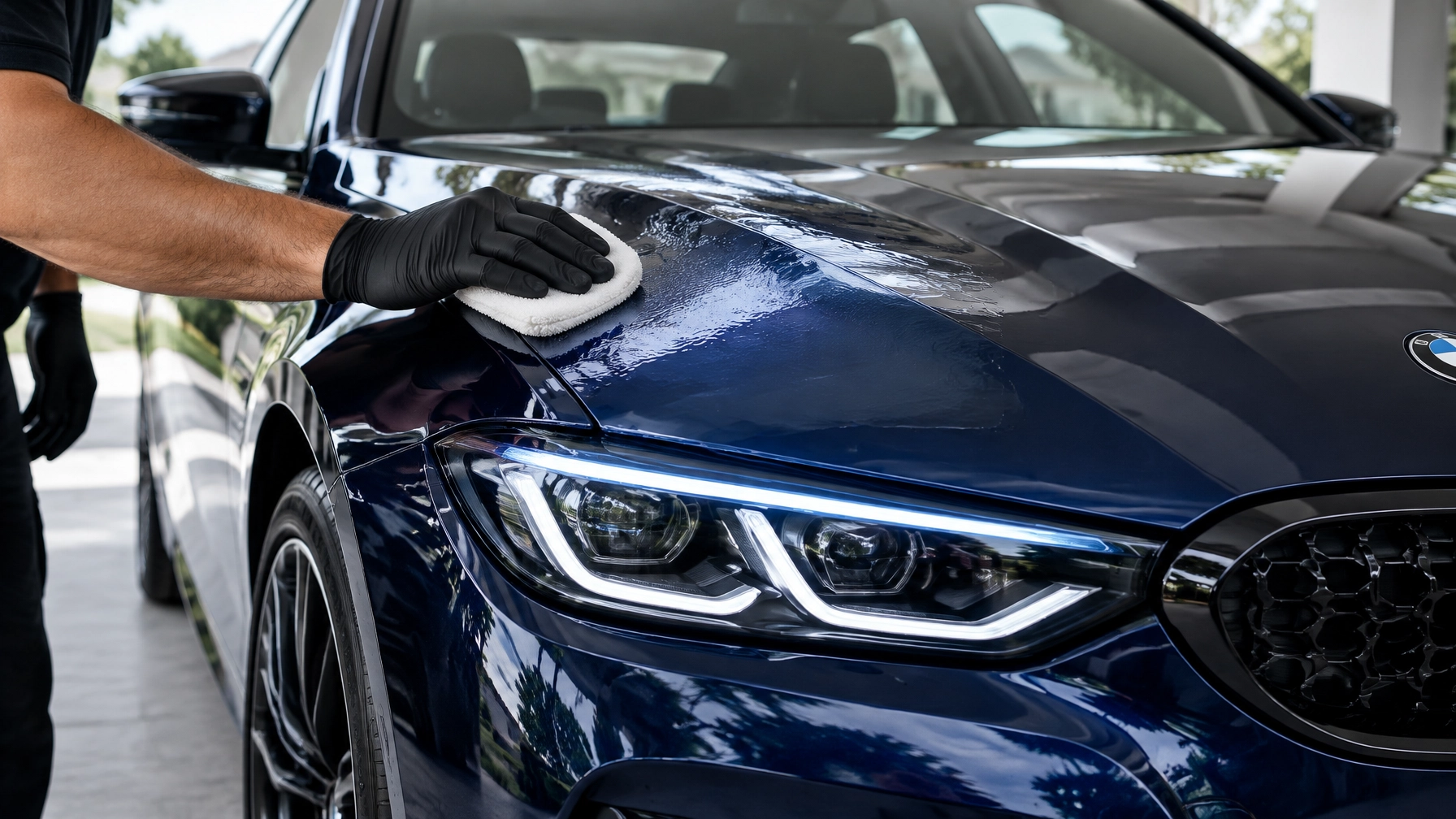
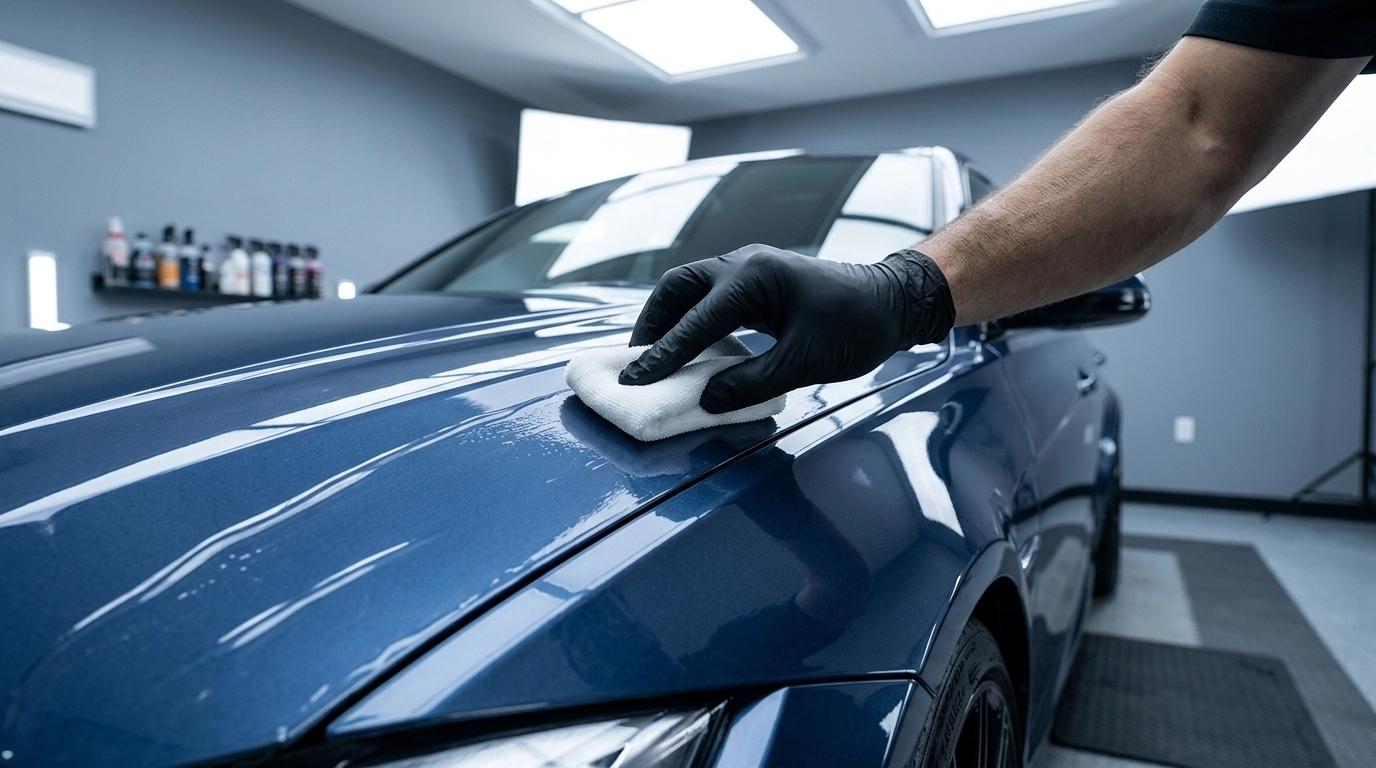
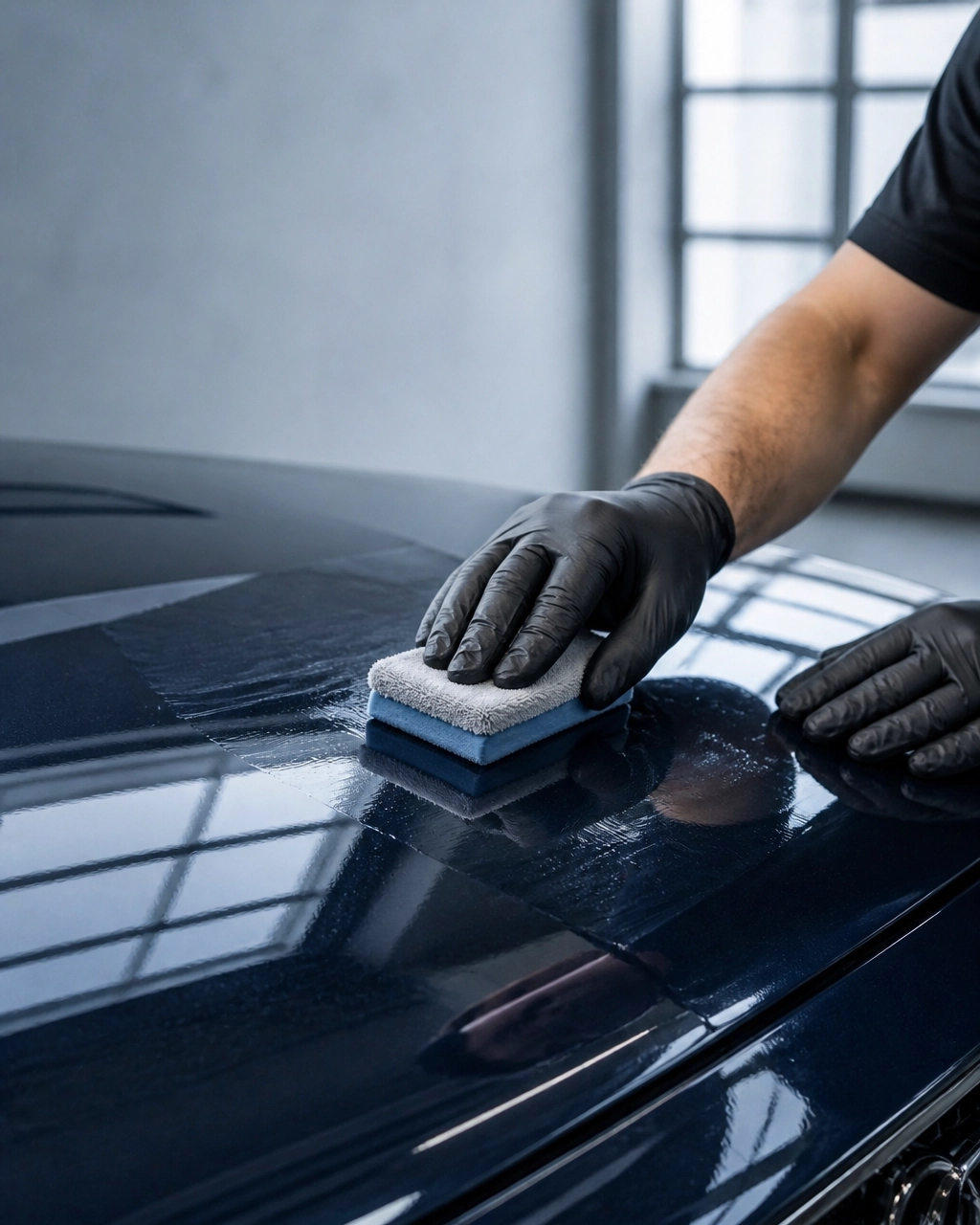
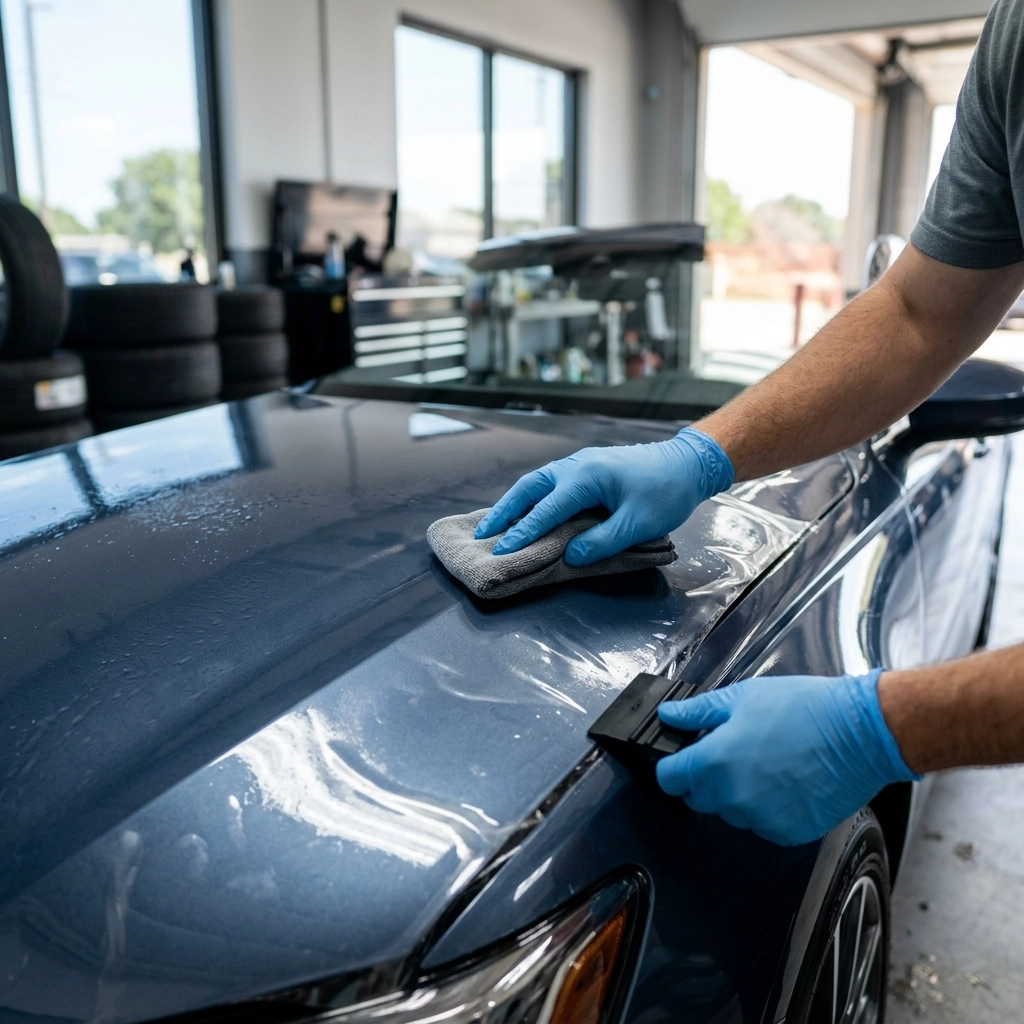
Liquid Paint Protection Film (LPPF) is a state-of-the-art, hand-applied protective barrier that bridges the gap between traditional ceramic coatings and thermoplastic urethane (TPU) films. Unlike traditional PPF, which is cut from a sheet and stretched over the car, LPPF is meticulously applied by hand in a liquid state. This allows the product to bond seamlessly to every contour, edge, and emblem without the visible seams or lifting common with traditional "clear bra" installs.
Its key advantage is advanced re-leveling technology. The polymer structure of LPPF is designed to be flexible and durable, so when a rock impact causes a blemish, the affected area can be re-leveled to restore a smooth finish. In Houston, that means your vehicle keeps a cleaner, more uniform appearance even after the daily abuse of freeway driving, construction zones, and road debris.

Caption: A close-up of the meticulous hand-application process, where a skilled installer uses precision tools to work the liquid film into the vehicle's contours, ensuring total coverage without seams.
Can Re-Leveling Technology Really Handle Houston’s Driving Conditions?
Yes, re-leveling technology is specifically engineered to handle the high-impact environment of the I-45 and Beltway 8 corridors. Traditional paint is rigid; when a piece of road debris or a grain of sand hits it at 70 mph, the paint chips because it has no "give." LPPF acts as a high-density cushion. It absorbs the energy of the impact and, thanks to its re-leveling properties, can often smooth over the indentation left behind.
This technology ensures that your vehicle maintains a mirror-like finish even after years of daily commuting. In cities like Missouri City and Stafford, where construction is constant and road debris is a daily hazard, this repairable re-leveling capability is the difference between a car that looks "used" and one that maintains showroom quality. Because the film is significantly thicker than a ceramic coating alone, it provides a much higher level of physical defense against the physical stressors of Texas driving.
Why Does an Owner-Operated Approach Result in Better Protection?
At Ceramic Enthusiasts, we operate on a "one car at a time" philosophy because paint protection is a game of millimeters and molecular bonds. High-volume shops often rush the decontamination and preparation phases to meet quotas. However, LPPF and premium coatings require a clinical environment and a meticulous eye. As an owner-operated business with over 10 years of experience, I personally oversee every stage of the process: from the initial multi-stage decontamination wash to the final curing of the film.
When you bring your vehicle to us, it isn't just another work order. We spend hours performing paint correction to ensure the surface is flawless before the LPPF is applied. If you lock in swirls or defects under a protective film, they are there to stay. Our dedicated focus ensures that the bonding process is perfect, which is critical in Houston’s humidity. We take the time to ensure the film cures correctly so it can withstand the 100+ degree days and torrential downpours common in Deer Park and La Porte.

How Does LPPF Complement Your Existing Ceramic Coating?
We often see LPPF and ceramic coatings as a powerhouse duo rather than competing products. While LPPF provides the heavy-duty physical protection and a hand-applied, repairable protective layer, a ceramic coating can be applied on top to provide extreme hydrophobicity and chemical resistance. This combination creates a surface that is nearly impossible for dirt, brake dust, and grime to stick to.
For many of our clients in Pasadena and Texas City, we recommend LPPF for high-impact areas like the front bumper, hood, and side mirrors, while using a premium ceramic coating for the rest of the vehicle. This hybrid approach offers the best of both worlds: the impact resistance of a film and the slick, easy-to-clean nature of a ceramic. Whether you are driving a luxury sedan or a heavy-duty RAM truck, this layered defense is the ultimate strategy for long-term preservation. You can view examples of these combined results in our gallery.
Why Is the Preparation Phase More Important Than the Product Itself?
You can buy the most expensive protection in the world, but if the surface isn't prepared correctly, it will fail. In the Houston area, vehicles are subjected to heavy metallic fallout from the refineries and salt air from the coast. Before any LPPF is hand-applied, we perform a comprehensive service that includes a chemical iron decontamination and a mechanical clay bar treatment.
This process removes embedded contaminants that a standard wash cannot touch. If these particles are left on the paint, they can cause "outgassing" or prevent the LPPF from bonding securely to the clear coat. By spending the necessary time on paint correction: polishing out existing scratches and oxidation: we ensure that the LPPF is being applied to a pristine surface. This is why our work lasts years, not months.

What Happens to Your Vehicle If You Ignore These Environmental Factors?
The consequence of inaction is clear: permanent clear coat failure. Once the UV rays have successfully thinned the clear coat to a certain point, the damage becomes irreversible. At that stage, detailing or coatings can no longer help; you are looking at a multi-thousand-dollar trip to a body shop for a full respray.
By investing in LPPF now, you are effectively "freezing" the condition of your paint. Whether you are located in Alvin, Dickinson, or Bellaire, the cost of protection is a fraction of the cost of restoration. Furthermore, the resale value of a vehicle with a documented, professionally applied LPPF is significantly higher. Buyers in the Houston market know how hard the weather is on cars; seeing a flawless, protected finish is a major selling point.
Ready to Protect Your Investment from the Houston Sun?
Your vehicle is one of your most significant investments. Don't let the Texas heat and humidity strip away its value and beauty. At Ceramic Enthusiasts, we provide the technical expertise and the specialized, one-on-one attention your car deserves. From our shop to your driveway, we ensure your vehicle is equipped to handle everything the Gulf Coast throws at it.
Whether you're in Webster, Rosenberg, or right here in Pasadena, we are ready to help you choose the right protection package.
Contact Ceramic Enthusiasts today at 281-626-9384 to schedule a consultation and see how our hand-applied Liquid Paint Protection Film can protect your vehicle and be re-leveled to restore a smooth finish when rock impacts leave a blemish.